
How Much Does a Music License Cost in the UK?
Music licence costs in the UK depend on your business type and music usage. Fees are calculated from factors like audible floor area, number of employees, and customer capacity.
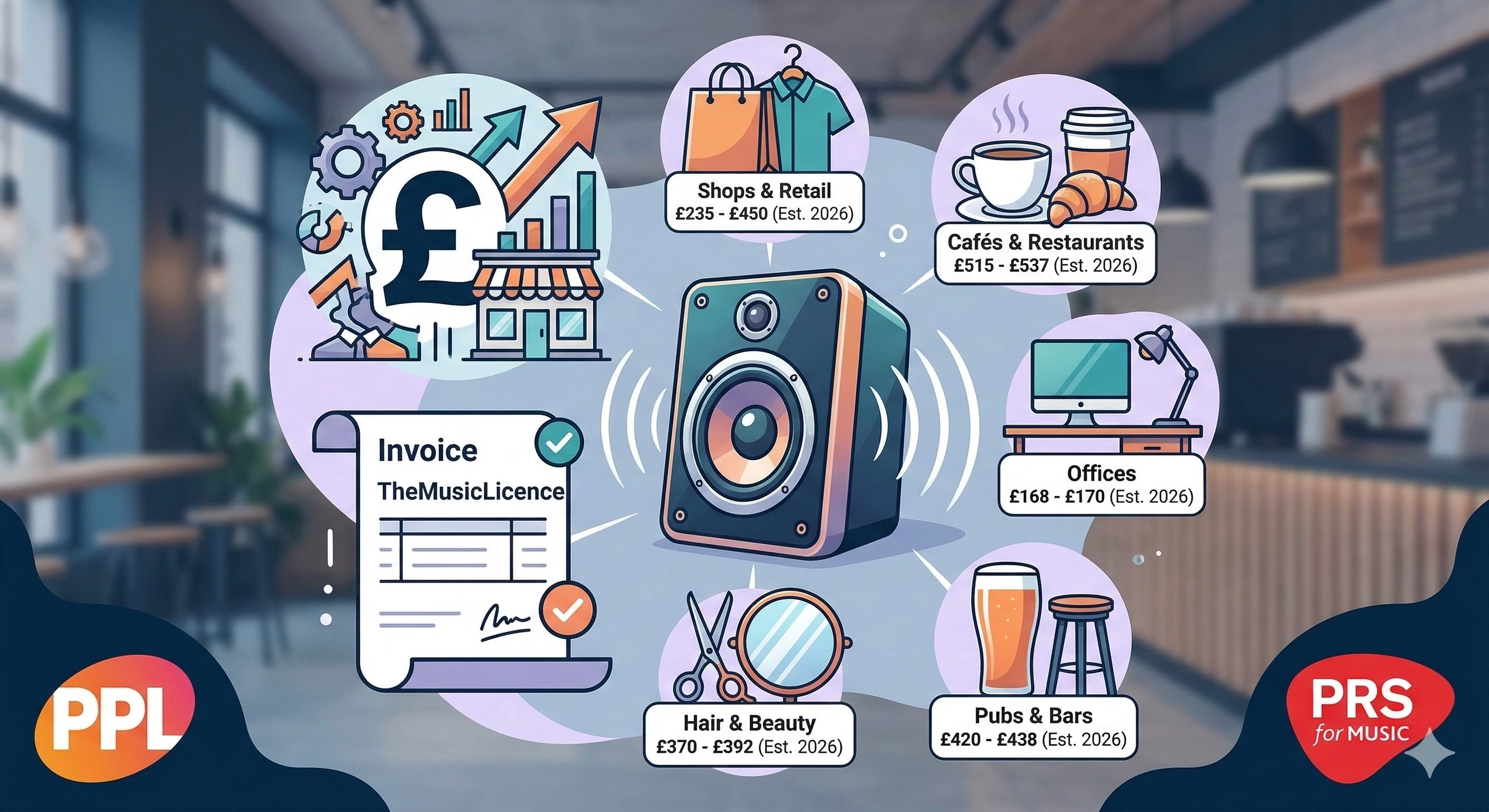
Annual costs start at around £168 for a small office and can exceed £515 for cafés and restaurants. Rates are higher for larger businesses or those hosting live events. For example, small shops may pay £235 to £450 per year, while pubs and bars using background music may pay from £420 annually.
Most businesses that play music for customers or staff need The Music Licence, which covers payments to PRS for Music and PPL to guarantee fair compensation for songwriters, publishers, performers, and record labels. Since pricing varies by sector and usage, review the tariff that applies to your business type to estimate your licence cost.

Who Needs a Music Licence?
Any business that plays music in a commercial environment where customers or staff can hear it will likely need a music licence. This includes businesses using music to create atmosphere, encourage customers to stay, or improve staff morale.
Based on the This applies to a wide range of settings, including shops, offices, cafés, restaurants, hair and beauty businesses, pubs, and bars. It also goes beyond playlists and speakers in customer-facing areas. For example, if music is played through a business sound system, used as background music, or played to callers on hold, a licence may be required.nt is that music used in a business is different from music played for private, personal enjoyment at home. If it forms part of your commercial environment in any audible way, it is important to check whether TheMusicLicence is needed.
Do You Need a Licence for Live or Recorded Music?
Yes, businesses may need a music licence whether playing recorded music as part of daily operations or using music for live entertainment. Background playlists in commercial spaces require proper licensing, and live events may bring additional requirements.arts with recorded music played through speakers in customer or staff areas. But the need for licensing can go further if you host DJs, karaoke nights, or live bands, as these uses are treated differently from simple background music and may require extra permissions on top of your standard licence.
As a result, the cost and type of licence depend on how music is used in your business. A shop or office playing background music is not treated the same as a venue hosting live performances or music-led events.
What Does TheMusicLicence Cover?
TheMusicLicence covers the legal right to play music within a business or commercial setting where it can be heard by customers, visitors, or staff. As the current article explains, it brings together payments for both PRS for Music and PPL, so that songwriters, publishers, performers, and record labels are fairly compensated when their music is used.
This includes background music played within your business premises to shape atmosphere, improve customer experience, or boost staff morale. It applies to commercial environments, not private listening at home.
The current article also makes clear that licensing can extend past standard in-store or on-site playback. For example, if you use music on hold for phone lines, there is a specific telecommunications tariff that may apply. It also notes that a personal streaming subscription such as Spotify, Apple Music, or Amazon Music does not cover business use, which is why businesses need both the Music Licence and a suitable commercial streaming provider.
If you would like, I can write the next section, ‘How Music Licence Costs Are Calculated,’ with the same style.
How Music Licence Costs Are Calculated
Music licence costs are not a single flat fee. PPL PRS applies specific tariffs customized to each industry, with pricing based on how music is used in your business.
Some of the main factors include audible floor space, the number of employees, and customer capacity. In other words, the amount of space where music can be heard, how many people are working in the business, and how many customers or guests you serve can all affect the final licence cost.
The type of business also matters. A small office, a retail shop, a café, and a pub will not necessarily be charged in the same way, because each falls under a different tariff structure. The article’s examples show that costs vary depending on sector, which is why businesses are usually assessed according to the category they operate in.
Another important factor is how the music is used. Background music in a standard commercial setting may be priced differently from music that plays a more central role in the business experience. The article also notes that businesses hosting live performances, DJs, karaoke, or similar events may need additional permissions on top of their standard background music licence, which can increase the overall cost.
So while the exact fee depends on the relevant tariff, the general rule is that music licence cost is determined by your audible area, business size, customer or staff numbers, business type, and whether you use music simply as background audio or as part of live entertainment or events.
Licence Music Cost by Business Type
Music licence cost varies by business type because different sectors are assessed under different tariffs. As the current article explains, PPL PRS uses tariffs customized to your industry, so there is no universal flat fee for every business.
| Sector | Metric | Est. Annual Cost (+VAT) |
| Retail & Shops | Small shop (up to 50m²) | £235 – £450 |
| Offices | Up to 4 staff members | £168 – £170 |
| Cafés & Restaurants | Up to 30 seats | £515 – £537 |
| Hair & Beauty | Up to 10 treatment chairs | £370 – £392 |
| Pubs & Bars | Background music (under 400m²) | £420 – £438 |
Here are the business examples covered in the current article:
Shops
For retail and shops, estimated annual costs range from £235 to £450 + VAT for a small shop up to 50m².
Offices
For offices, the article gives an estimated annual cost of £168 to £170 + VAT for premises with up to 4 staff members.
Cafés and Restaurants
For cafés and restaurants, estimated annual costs range from £515 to £537 + VAT for venues with up to 30 seats.
Hairdressers and Beauty Salons
For hair and beauty businesses, the article lists estimated annual costs of £370 to £392 + VAT for businesses with up to 10 treatment chairs.
Pubs and Bars
For pubs and bars using background music in premises under 400m², the article gives an estimated annual cost of £420 to £438 + VAT.
Live Performances or One-Off Events
Costs increase when music is more than background use. Hosting live performances, DJs, karaoke nights, or similar events may require additional permits beyond the standard music licence. Venues running music-led events or one-off entertainment should expect higher overall costs than those playing only background music.
Other Business Types
While the current article does not give pricing examples for hotels, guesthouses, nightclubs, sports grounds, members clubs, churches, health facilities, bingo halls, bowling alleys, cinemas, or casinos, the same principle applies: the final licence cost depends on the tariff for that sector and how music is used within the space.
Since pricing is dependent on factors including audible floor space, staff numbers, customer capacity, and the role of music in your business, the most accurate cost depends on your business category.
What Is PPL PRS and Why Do Businesses Pay Both?
PPL PRS is the joint licensing system behind The Music Licence, which most UK businesses use when they want to play music legally in a commercial setting. As the current article explains, this brings together the two main collection societies into one route, making music licensing simpler for business users.
Businesses pay both because different people involved in a song are paid through different organisations. PRS for Music collects royalties for songwriters and publishers, while PPL collects royalties for record labels and performers. In other words, one side covers the rights in the composition, and the other covers the rights in the recording.
By obtaining The Music Licence, a business covers both rights at once rather than dealing with them separately. This is the standard route for most businesses that play music for customers, visitors, or staff, guaranteeing everyone involved in creating and recording music is fairly compensated.
Do I Need a Licence to Play Recorded Music in My Business?

Yes, in most cases, if you play recorded music in your business, you will need a music licence. The current article explains that when music is used in a commercial environment rather than for private listening at home, it usually requires The Licence.
This applies whether you play music for customers, visitors, or staff as part of your business environment. Background playlists used to shape atmosphere, improve customer experience, or boost staff morale are considered business use. Even if music is only playing in the background, you may still need the correct licence.
A personal subscription to services like Spotify, Apple Music, or Amazon Music is not sufficient for commercial use. These platforms are for private listening, so businesses need both the appropriate licence and a suitable commercial music provider.
In simple terms, if your business uses music in a way that others can hear it, you should assume that legal permission is required and check whether The Licence applies.
Can I Play Spotify, Radio, TV, or YouTube in a Business?
Not automatically. The current article makes clear that using music in a commercial setting is different from private listening at home, which means businesses need the right legal permission before they play music for customers, visitors, or staff.
A personal subscription to Spotify, Apple Music, or Amazon Music does not cover business use. These services are for private, non-commercial listening and are not sufficient for commercial music in your business. To stay compliant, businesses need The Music Licence and a suitable commercial streaming provider. Auracle Sound offers commercially licensed music streaming and reliable players for UK businesses, with professionally curated channels designed for public performance.
While the article does not go into separate detail on radio, TV, music channels, or YouTube specifically, the same principle applies throughout: if music is being used in a business environment rather than a private home setting, it falls under different rules and may require the correct licence. The purpose of The Music Licence is to make sure the relevant creators and rights holders are paid when music is used commercially.
If you want to play music through streaming providers or other media in your business, do not assume a personal account or ordinary access gives you the right under UK copyright laws.
What About Royalty Free Music?
The current article does not go into detail about royalty free music, but it does make an important distinction between personal listening and music used in a commercial environment. It also explains that businesses need the correct licence and a suitable commercial music provider when using music in their premises.
In practical terms, royalty free music may reduce some of the complexity around music licensing because it is often supplied under a licence that already allows certain types of commercial use. However, that does not mean every track labelled royalty free can automatically be used in every business setting without checks.
The key issue is the exactThe key issue is the specific commercial terms attached to the music. Businesses must confirm whether the track or service allows use in customer-facing environments, as background music, or across multiple locations. Some royalty free licences are broad, while others may restrict business use.usic can sometimes be a simpler option, businesses should always check the provider’s licence terms carefully before they play royalty free music in a commercial setting.
Looking for a PRS/PPL-Free Alternative?

If you want background music for your business without the ongoing PRS/PPL fees, Auracle Sound also offers a non-copyright option through Auracle Sound X Rehegoo Royalty Free Music.
Through this service, businesses can access fully licensed royalty free music designed for public performance in the UK and beyond. Rehegoo’s content is available on Auracle’s reliable IP audio receivers, giving businesses a practical alternative to traditional commercial music licensing.
Because the content is fully licensed for public performance, businesses using this service can avoid standard PRS/PPL fees in the UK while still creating a professional in-store atmosphere. The system works as a store-and-forward service, with licence-free content stored on the receiver’s internal solid state drive and scheduled for day-parted playback throughout the day.
For multi-site businesses, any location with a network connection can also be remotely monitored and updated out of hours, making it a flexible option for brands that want simple, managed background music across one or more venues.
To find out more about Royalty Free Music via Auracle Sound in the UK, ROI, and the EU, get in touch:
Call: +44 20 7112 7504
Email: info@auraclesound.co.uk
You can also explore more from Auracle Sound, including Music Streaming, Players, Sectors, Case Studies, and Contact options.
What Happens If You Play Copyrighted Music Without a Licence?
If you play copyrighted music in If you play copyrighted music in your business without the proper licence, you could face extra costs and compliance issues. If PPL PRS discovers unlicensed music use, they may apply a 50% surcharge on the first year’s fee.ight legal permission in place can increase your overall licence cost, rather than saving money. Instead of simply paying the standard fee, a business may end up paying more once unlicensed music use is identified.
The article’s message is clear: getting TheMusicLicence in place early helps businesses stay on the right side of the rules and avoids unnecessary extra fees. In that sense, the licence does more than just allow music use — it also guarantees adherence by covering the rights of songwriters, publishers, performers, and record labels when music is played in a commercial environment.
So while the current article does not go in detailed examples of legalWhile the article does not provide detailed legal examples, it makes clear that businesses should be proactive, not reactive, about music licensing.sses can use the PPL PRS website, where TheMusicLicence is available for organisations that use, play, or perform music in a commercial setting. The official site also explains that the cost will vary depending on your business type, size, and day-to-day music use.
The right licence depends on the tariff for your business. Commence by reviewing the relevant music tariffs for your sector, as PPL PRS groups pricing by venue type and music usage. The official tariffs section lists categories for different businesses and notes that pricing can vary, so some businesses may need to request a direct quote.
In practical terms, that means businesses should first identify how they use music — for example, background music, music on hold, or live entertainment — and then check the sector or tariff that best matches their premises. The official guidance says that, in most cases, both a PPL and PRS for Music tariff will apply through TheMusicLicence, which is why checking the correct category is so important before applying.
Once you know your business category and music usage, use the PPL PRS site to determine which licence is most relevant to your setup.
Music Tariffs Explained
Music tariffs are the pricing categories used to work out your music licence cost. Rather than charging every business the same flat fee, TheMusicLicence uses different tariffs based on the type of venue and the way music is used in that business.
In most cases, a business’s licence cost is built from both a PPL tariff and a PRS for Music tariff. PPL PRS explains that tariffs are set separately by PPL and PRS for Music, and the ones that apply to your business determine how your final cost is calculated.
Tariffs vary by sector and music usage. Official categories include workplaces, hair and beauty salons, pubs, bars, restaurants, cafés, hotels, sports venues, members clubs, telephone music on hold, and specially featured entertainment. Music licence cost changes depending on business type, size, and whether music is used as background audio or as a central feature.
So, in simple terms, music tariffs are the rules and rate structures that decide what your business pays for TheMusicLicence.
FAQs About Music Licensing
Do I need both a PPL licence and a PRS licence?
In many cases, yes. The current article explains that TheMusicLicence brings together payments for PPL and PRS for Music in one route. This matters because different parts of a song are protected in different ways. PRS for Music, sometimes associated with the wider role of a performing rights society, covers songwriters and music publishers, while PPL, linked to Phonographic Performance Ltd and phonographic performance rights, covers performers and recording rightsholders.
Why do businesses need a music licence at all?
A music licence gives a business the legal permission to use music in a commercial settingA music licence gives a business legal permission to use music in a commercial setting. Whether licensing music for background use or entertainment, the licence ensures artists, musicians, publishers, performers, and labels are fairly paid. In simple terms, it secures compliance when music is played outside private home use.u play music in cafes pubs, guesthouses restaurants, or theatres hotels, you may need the appropriate licence if customers or staff can hear it. The same general principle applies across many sectors where music is part of the environment.
Do beauty salons, cinemas, factories, and hairdressers need one too?
They often can. The article already shows pricing examples for hair and beauty businesses, and the same logic can extend across commercial spaces such as beauty salons cinemas and factories hairdressers where music is played for staff or customers.
Do casinos, social clubs, sporting facilities, and public venues need a licence?
Potentially, yes. Businesses and venPotentially, yes. Businesses and venues such as casinos, social clubs, sporting facilities, community halls, public transport environments, and other public-facing settings may need a licence if music is used in a commercial or shared space.treaming services, or other equipment?
Personal subscriptions do not cover business use. If music is played through speakers, screens, or other digital devices, you must check whether your usage is properly licensed for a commercial setting.
Do I need extra permission to stage live music events?
Possibly. Businesses that stage live music events, host DJs, or run karaoke nights may need additional permissions past standard background music cover. If your business wants to play live music or host performances, your costs and licensing needs may increase.
Does a licence cover live performers as well as recorded music?
Standard background music cover is one thing, but live or recorded music can involve different requirements. If your venue hosts performers, bands, or entertainment nights, extra permissions may be needed beyond the usual licence.
Why does music licensing matter on such a large scale?
Because music licensingMusic licensing supports a large creative ecosystem. Licence fees help compensate writers, publishers, performers, and labels. Across the industry, this supports hundreds of thousands of creative contributors and businesses connected to music use.way to think about music licensing?
A simple way to view itSimply put, if your business plays music in a commercial environment, you likely need permission. The licence ensures publishers, performers, labels, and recording owners are paid fairly when their work is used.so turn this into a more SEO-styled FAQ with shorter answer lengths for featured snippet targeting.
If you’re running a business, you already know that the right playlist can transform your atmosphere, keep customers browsing longer, and boost staff morale. But before you hit “play,” there’s a crucial legal step: securing TheMusicLicence.
At Auracle Sound, we help businesses curate the perfect soundscape while staying compliant. To help you budget for the year ahead, we’ve broken down what you can expect to pay for music licensing in the UK.